Americans living paycheck-to-paycheck
At-a-glance summary
What we studied: How Americans experience and navigate living paycheck-to-paycheck, using mixed-methods research inside a large U.S. credit platform.
What we found:
Financial instability is driven by shocks and structural constraints, not poor budgeting.
Once destabilized, people enter a self-reinforcing debt cycle that is difficult to exit without systemic support.
Why this mattered: Paycheck-to-paycheck living is a dynamic, long-term condition, shaped by past events, constrained cash-flow, and cognitive load under scarcity—not a series of bad choices.
Impact: These findings reframed company strategy, shifting focus toward cash-flow stability, collections clarity, and structural support—including a bank acquisition to better serve paycheck-to-paycheck users.
Project background
Despite widespread media attention, the lived experience of financial instability remains poorly understood. Roughly 41% of Americans have less than $2,000 in savings, a threshold below one month of necessities. Behavioral science suggests that scarcity narrows cognitive bandwidth, leading to short-term, survival-oriented decision-making. This study investigates how financially vulnerable consumers experience, describe, and navigate the paycheck-to-paycheck cycle using a multi-method research program within a large U.S. credit platform.
Research questions
How do financially vulnerable individuals define “living paycheck-to-paycheck”?
How does financial instability begin and evolve over time?
What structural and behavioral mechanisms reinforce instability?
Methods & participants
Participants were recruited from a large financial platform, Credit Sesame.
We used a mixed-methods triangulation framework combining:
Literature review
On-site intercept surveys (n ≈ 1100)
Behavioral analytics from millions of credit files
Semi-structured interviews (n = 12)
Systems modeling (cycle, timeline, opportunity tree)
Findings
Finding 1. Defining “Paycheck-to-Paycheck”
Participants converged on a functional definition:
“If I miss one paycheck, I cannot cover next month’s necessities.”
Quantitatively, this typically meant:
Less than $1,000 in leftover income after essentials
Less than $2,000 in liquid savings
High fixed expenses (rent, childcare, transportation, medical payments)
This user-derived definition provides an empirical operationalization of “paycheck-to-paycheck” grounded in lived experience rather than moral narratives.
Finding 2. Pathways Into Instability: The Shock-Initiated Debt Cycle
Across interviews, current financial precarity was consistently mapped back to one or more destabilizing financial shocks (e.g., medical event, job loss), which initiates borrowing, which reduces future cash-flow via payments, interests, and penalties, preventing savings and increasing vulnerability to subsequent shocks. This model explains the persistence of financial instability as a structurally reinforced feedback loop rather than a sequence of isolated events.
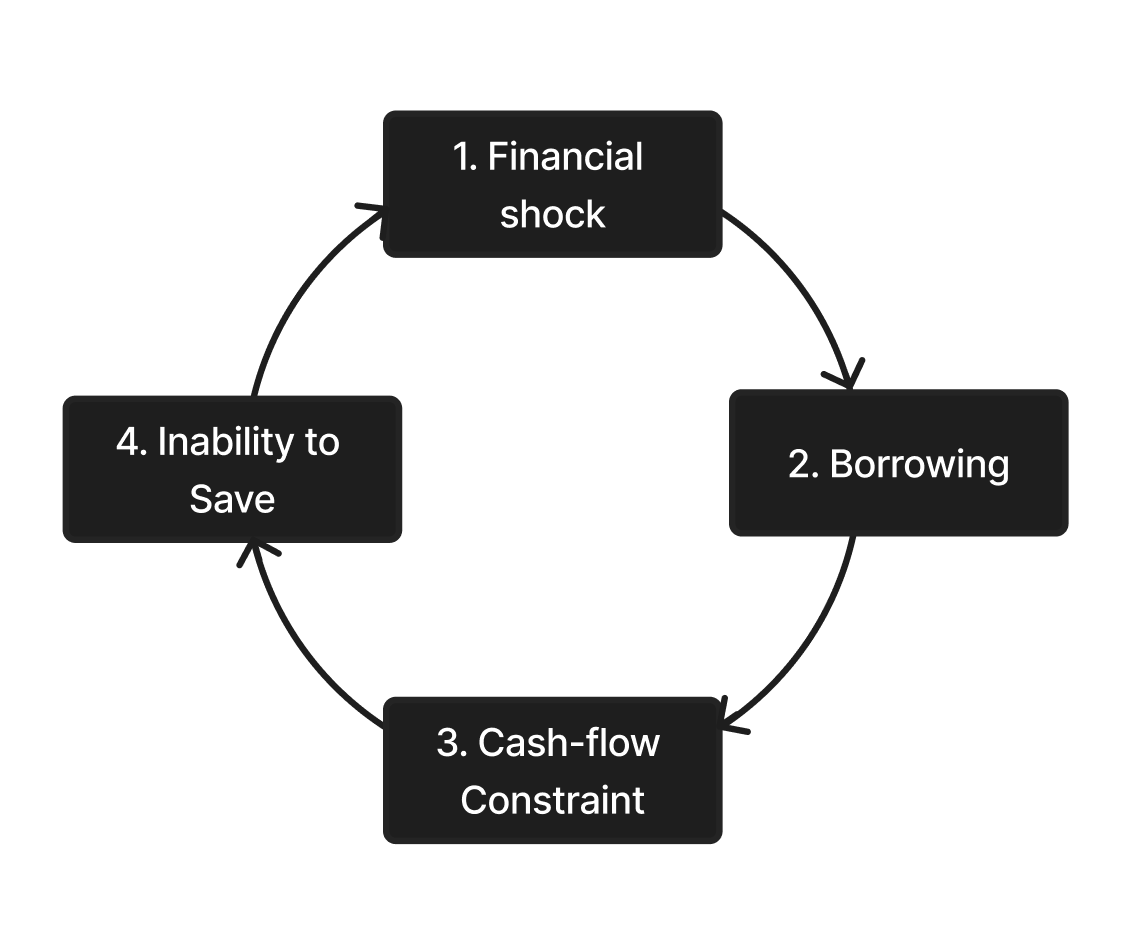
Figure 1. Debt Cycle Model.
Finding 3. A Temporal Model of Financial Instability
Participants’ narratives could be synthesized into a common temporal pattern: early constraints, a destabilizing shock, sustained present-day precarity, and future-oriented hopes. The temporal model highlights that financial instability is not a static state but a dynamic trajectory shaped by prior events and constrained futures.
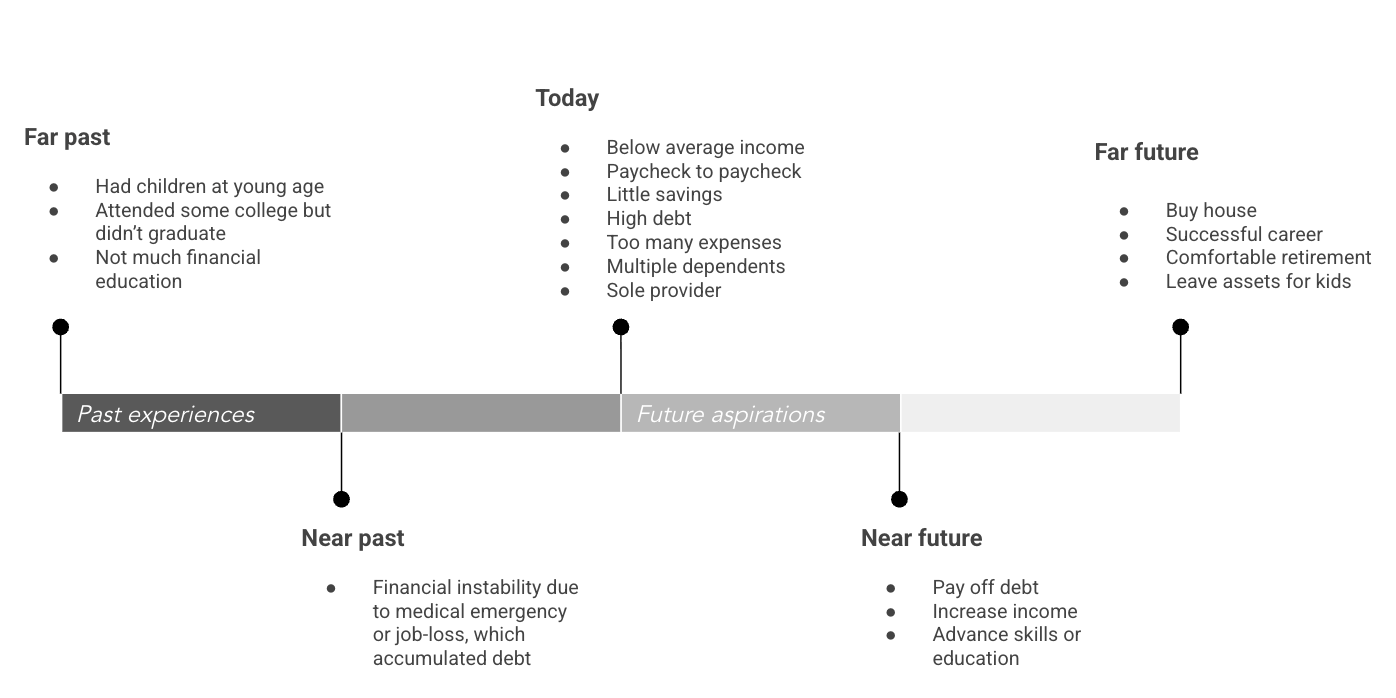
Figure 2. Temporal Instability Timeline
Finding 4. Root Causes: The Opportunity Tree
Synthesis across data led to a root-cause framing centered on a top-level problem:
“I am not prepared for an unexpected expense.”
The opportunity tree is a functional decomposition of why users are unprepared for unexpected expenses, separating “cash-flow in too low” from “cash-flow out too high,” and identifying sub-causes and possible intervention points. It highlights structural drivers and identifies where interventions—product, policy, or educational—are most likely to have leverage.
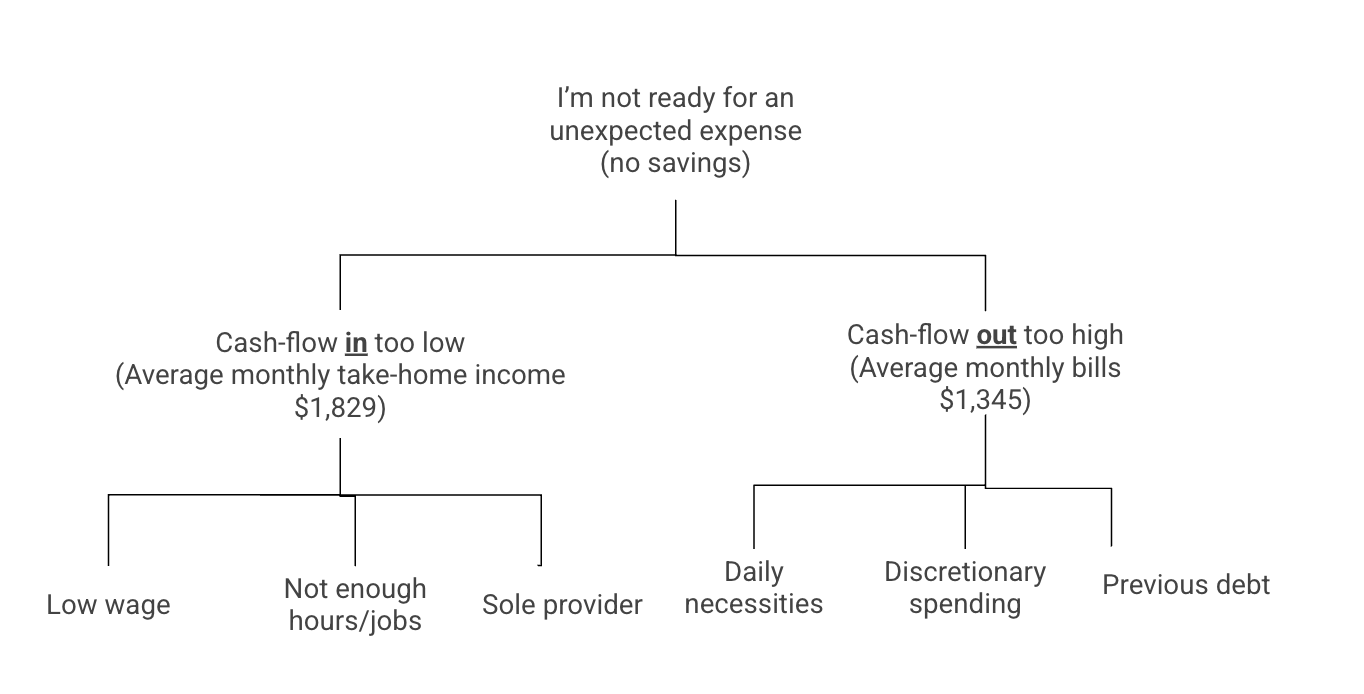
Figure 3. Root-Cause Opportunity Tree.
Finding 5. Deeper Dive: The Burden of Collections Debt
Credit analytics revealed:
63% of financially vulnerable users had at least one open collection
The mean collection balance was approximately $963
Collections were present across the full range of credit scores
Survey analysis found:
25% of users with collections were unaware they had them
Of those who were aware, 60% were not making payments
Follow-up interviews indicated that non-payment was driven by:
Confusion about which collections were valid
Fear of engaging with collectors
Shame and avoidance
Perception that payments would not materially improve their situation
These findings suggest that collections are both a financial burden and a cognitive/emotional burden, reinforcing the broader scarcity trap.
Implications & impact
Design Implications
For financial products and services, the findings highlight the need to:
Provide clear, actionable information around collections (what is owed, to whom, and what options exist).
Reduce cognitive load by simplifying decision paths and automating small, incremental steps (e.g., micro-savings, payment plans).
Align bill due dates with pay cycles where possible to reduce predictable shortfalls.
Treat financial vulnerability as an ongoing state shaped by past events, not a single moment of “bad choices.”
Policy Implications
At a policy level, the models suggest that:
Mitigating income volatility and medical debt could substantially reduce the number of households entering the debt cycle.
Strengthening safety nets around shocks (e.g., paid leave, emergency aid) may prevent the initial descent into instability.
Reforming collections processes and penalties may reduce both financial and cognitive burdens on already vulnerable households.
Organizational Impact
This research shifted internal understanding of financial instability from individual failure to structural vulnerability. Evidence showed that many users lived paycheck-to-paycheck due to shock-driven debt and systemic constraints, not poor budgeting. As a result, the company reframed paycheck-to-paycheck users as a core audience and redirected strategy toward addressing root causes such as cash-flow volatility, collections confusion, and financial scarcity. These insights informed a broader product and identity shift, including the acquisition of a bank and the development of tools for emergency savings, cash-flow smoothing, and debt resolution.
Conclusion
Living paycheck-to-paycheck is often framed as a personal failing, yet the evidence from this study points to a systemic, shock-driven, and structurally reinforced condition. Through mixed-methods triangulation and conceptual modeling, we show that financial instability is the logical consequence of past shocks, constrained cash-flow, high fixed costs, and cognitive load under scarcity.